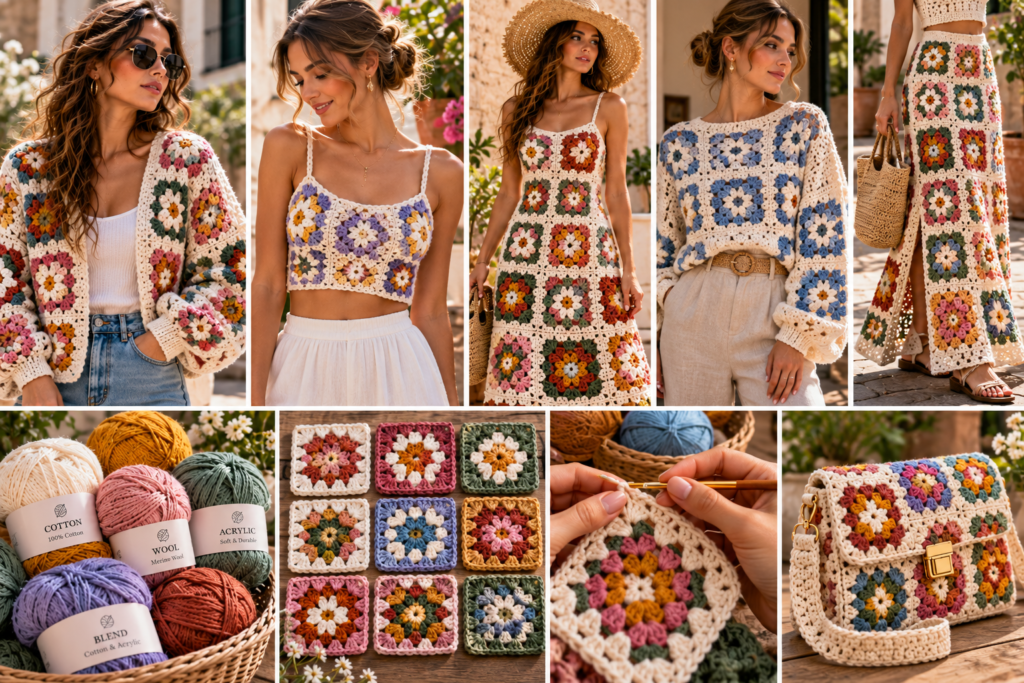
Sewing offers another way to join granny squares. A carefully executed seam can be relatively flat and discreet.
This method is useful for garments where comfort and a less prominent seam are priorities.
Use a suitable yarn or sewing thread and avoid pulling the seam too tightly. The joined fabric should remain flexible enough for comfortable movement.
Continuous Joining Methods
Some crochet techniques allow motifs to be joined as the final round is worked. These methods can reduce the number of separate finishing steps.
They require careful attention to the pattern and motif placement, but they can be efficient for large projects.
Whichever method you choose, test it on a small sample before assembling an entire garment.
- Getting the Size Right: Gauge and Measurements
A granny-square garment can look beautiful but still be uncomfortable if its dimensions are incorrect.
Because each motif contributes to the overall size, small variations can accumulate across a large garment.
Measure the Finished Square
Crochet several sample squares using the chosen yarn and hook. Measure them after any blocking or finishing process that will be used for the completed garment.
If a square is larger or smaller than expected, adjust the hook size or tension before making the remaining motifs.
Calculate the Garment Dimensions
For a simple panel, multiply the number of squares across by the width of one finished square.
Share your thoughts
We'd love to hear your perspective. Keep it thoughtful and respectful.